We had a chance to delve some of the Vault of the Goblin last night with friends from college who we haven't gamed with in about 15 years. It was a blast! They played a group of four level 4s (two elf champions, a dwarf myrmidon and a human fighter) along with my human cleric 3 (who was REALLY needed) and broke up the activities of the Cult of the Dragon behind a mirror that Mary's character had previously discovered but had not yet explored. I made a few discoveries in the process...
1. The minimal rules serve well. At some point, rules begin to, by their nature, minimize options. They become more about what you cannot do in a situation than what you can. To whit: the fellowship met a banshee early on. I am going with the B/X banshee that is the remains of an elf maiden. We had already established that Mary's character is a member of the elf nobility - so she asked if she knew who this elf was, and if she could speak with her. She made a few good rolls, and before long had made a positive connection, and the banshee really wanted to be helpful - willing to tell the fellowship all she could. However, I had no idea that they'd ask to pick up her body (which the banshee was still connected to), carry it around, and use the banshee as a portable auto-kill machine. I set a chance each turn that the banshee went all crazy on them and turned full banshee, but it never happened. They kept motoring through the complex - well after they had exhausted all of their healing, spells and extra resources - and kept letting the banshee wipe out their foes. The big fight - with a 6 HD hydra - ended quick when it failed its save. The other big fight, against an 8 HD salamander and his tribe of troglodytes, ended much more quickly when the banshee took out all but one of the trogs.
As the session wore on, my friend razzed me in good humor about how they had messed up my plans. I wasn't quite sure what he meant, but as I thought about it, I realized a key difference in my approach to adventure design today compared to me from 15 years ago... back then, I was a master railroad builder. I would write a story, and then decide where and how in that timeline the PCs fit in. The success or failure of the adventure, to my eyes, ended up being how well the PCs followed the script.
Yeah. I was that guy. I didn't even realize it until last night.
However, there was no plan. For each sub-section of the dungeon, I'm putting in a few factions with competing interests, putting in a few hooks for the fellowship to decide how to handle, and then letting the chips fall where they may as things go on. The fellowship could have infiltrated the cult from within, charmed the leader and had him write a new constitution for the cult turning them into a holy order of bee keepers, or tried to kill the leader, take his ring of serpent friendship, and try to ride the hydra like a six-headed steed while they took over the whole dungeon. It was all good with me.
In short, I like where the Vault of the Goblin is headed, and I think it's going to be a fun environment for others to play with once it's done. It's ending up very open-ended and dynamic.
Now, on to specific game stuff:
The decision to change the ability score range to 2-12 was met with some skepticism, but by the end of the night I think that they were converts. There were so many times that I had to ask for an ability check on the fly, and that was a great way to resolve the situation. The strong characters tended to have success doing things that strong people can do, and the weaker characters didn't. It plays very clean and intuitive. The difference between a 9 and 10 strength is a big deal in a lot of ways (5% chance to succeed on a check and +1 modifier) ...
In combat, they missed a LOT, but that was more a function of the dice rolling (which was almost uniformly bad - if not for the banshee, they would have suffered a TPK at some point, I'm confident - three troglodytes used up half of their resources in the first fight!), but I realized that the numbers are eventually going to scale out of control. In the draft I have going, you get to add your level (monsters add their HD) to all attack rolls. Since the game only scales to level 12 for PCs, a +12 bonus isn't too bad... until you do the math.
A fighter 12 gets +12 to hit. Fine. However, he also is going to be wearing something that increases his strength (I mean, he's a level 12 fighter) meaning that (conservatively) he has +3 from 14 strength and gauntlets of ogre power... and he is using a sword +3 (the best available in the game)... so now he is rolling 1d20 +18 to hit. So far, I like it - the bonus never scales past the die, making the die roll important...
Assuming that a foe will ever have AC that high. The same fighter is wearing plate +3 (total bonus +9) and carrying a shield +3 total bonus +4). Even a little bit of DEX gives him the max available bonus (+1) for that armor type, putting him at AC 10 (base) +9+4+1= AC 24. This means that he only needs a 6 on the die to hit a foe with maximum possible protection. Few monsters are going to have better than AC 25 - even at the highest levels.
I could scale this back considerably by only having the bonus tick every other level. Instead of adding your level to the attack roll, you add half your level (rounded up). At levels 1-2 (or 1-2 HD), you take +1 to hit; at level 3-4 (or 3-4 HD), you take +2 to hit... this drops my theoretical fighter 12's level bonus by 6 points, making his total attack modifier +12. This is MUCH more manageable. Now, against a moderately-armored foe (AC 18) he only needs a 6 on the die, and against a very well-armored foe (AC 22), he needs a 10 on the die. This keeps all of the numbers under control, and continues scale well enough - a 20 HD monster (just about the cap for this game as far as I can see - we're talking Tiamat here) gets +10 (base) to hit, although there will have to be some function for giving bonuses based on exceptional ability. I don't want to get into giving monsters ability scores (although that might be necessary with how much I use them... grrr) but that would allow the numbers to align better on the monster side of things. It's a little extra math, but having that information handy for monsters might be useful... something to ponder further.
One more thing and then I'll let you go (if you're read this far, good on you!) ... I realized that the character sheet is perfect EXCEPT for spells. I am going to create a second page only for those with spellbooks to use to record their spells and available slots. It's too much information, even for a level 4 caster, to fit on the front of the page in that little magic box. This way, only casters need to print out the second page of the character sheet - everyone else sticks with the one-pager.

Sunday, July 13, 2014


Wednesday, July 9, 2014
More Maps
The second level of the Vault of the Goblin is, in large part, a tribute to the Temple of Elemental Evil. The idea here is that the goblins split into several factions worshiping primal elemental deities, and developed sub-levels with elemental energies and rudimentary temples. The area I worked up for +Erik Tenkar (that I posted yesterday) is the elemental earth region. Today, you get the crossover (which is accessed through a tesseract in the northern square area) and the hall of flame (with the huge forge that fire giants are currently trying to cut out). I am using graph paper that's a little dark, so I'm having trouble scanning out the grid without also losing line work... I'll keep plugging away at that.


Tuesday, July 8, 2014
Tenkar's Halls - or if loving a map is wrong, I don't want to be right!
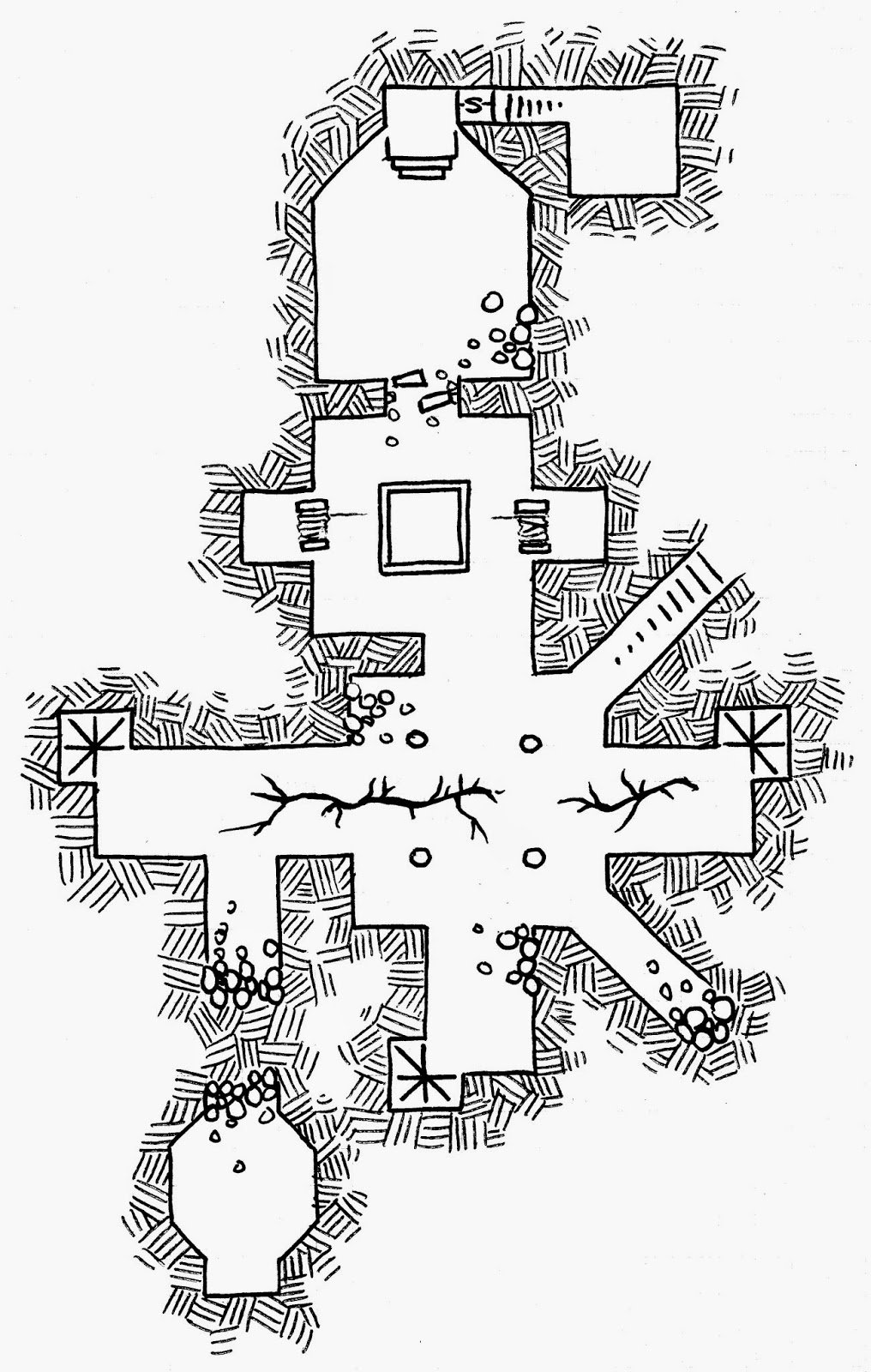
Here are the two maps that I've worked up and am sending to +Erik Tenkar to stat up for his part of the Vault of the Goblin. Man but I love these maps. I think the idea that someone else was going to be filling it in forced me to try and tell a little more story in the visuals. I tend to think of maps as a canvas on which I am going to layer the written adventure. For these, I didn't have that luxury - I designed knowing that the map was going to be my only contribution, and it had better do something on its own. I am quite happy with the result, and cannot wait to see what Erik does with it...

Monday, July 7, 2014

Saturday, July 5, 2014
Comparative Stat Blocks
In an effort to tighten up monster stat blocks and give a little more information, I'm playing with formats. Here is a before and after for the Cockatrice... I don't know if I'm sold on this, but it's a work in progress...
Cockatrice
|
Armor Class:
|
13
|
No. Appearing:
|
1d4 (2d4)
|
|
Hit Dice:
|
5d6
|
Save:
|
+8
|
|
Move:
|
30’ (60’ flying)
|
Morale:
|
+10
|
|
Attacks:
|
1 beak
|
Treasure:
|
Standard
|
|
Damage:
|
1d6 + petrify
|
Alignment:
|
Neutral
|
The cockatrice, a
small magical monster with the head, winds and tail of a rooster but the tail
of a snake, attacks with its beak. Any creature struck by the beak must save or
turn to stone. Cockatrices may be found anywhere.
Cockatrice
|
Neutral Medium
Fantastic Creature, CR 6
|
|
5d6 HD (20
hp); AC 13; Save +8; Morale +10; Move 30’ (fly 60’)
|
|
Attack: 1 beak (+5/1d6) + petrify on touch
|
|
Standard
Treasure; 1d4 appearing (2d4 in lair)
|
The cockatrice, a
small magical monster with the head, winds and tail of a rooster but the tail
of a snake, attacks with its beak. Any creature struck by the beak must save or
turn to stone. Cockatrices may be found anywhere.
Friday, July 4, 2014
Backgrounds for Saga of the Splintered Realm
One of the 5E features that I'm liberally swiping is the idea of backgrounds as an important part of your character. Rather than having these come with a specific suite of skills and a lockstep approach (which I find pretty constraining as presented), I'm thinking a more free-form approach... here's my first draft of this. Some of the descriptions are incomplete, and I think the core rules should have about 20 to choose from (there are 14 here, and it's pretty thorough - although not much for a magic user)...
Backgrounds
Backgrounds represent a variety of training, experiences and jobs that
your character participated in before becoming an adventurer – and which your
character might continue with while not busy slaying goblins and looting tombs!
Your background gives you a +2 modifier to any
non-combat check where that background may apply. For example, your background
as a woodsman gives you +2 to sense
checks while in the woods, +2 to sneak rolls while in a natural setting, +2
to INT checks to identify an unknown plant, and +2 to WIS checks to calm a wild
animal. You will never apply this in a combat situation; you cannot take a +2
bonus to your attack roll or saving throw because you are fighting a natural
animal!
Rather than listing every possible application of the
background, a general description is provided. Be aware that backgrounds often
overlap, and the skills layered within the background are not mutually
exclusive: a farmer and a woodsman have many common skills, but each also has some
unique skills.
You are also free to generate your own backgrounds. The
GM is encouraged to be as flexible as possible in considering the scope of the
background; as a farmer, you would have experience with not only planting and
the soil, but with weather, the behaviors of common pests like mice, spiders
and ants (and their monstrous varieties), with haggling in the marketplace, and
with maintaining tools and equipment. Whenever one of these situations arises
(identifying the type of bite from a monstrous insect, distinguishing a quality
item from an inferior one, guessing how the weather is going to be tomorrow morning),
your background as a farmer should grant you a situational bonus.
You are allowed to take two backgrounds for your
character. You can either select these or roll for them. As a human, you can
select any two backgrounds you desire. As a demi-human (dwarf, elf, stoutling),
one of your two backgrounds is pre-set.
Instead of taking two backgrounds, you may elect to
double up on the same background; instead of +2, you take +4 in this
background.
Acolyte. You have experience
in religious practices, history, rituals and rites.
Aristocrat. You have
experience in the upper echelons of society, gathering deep knowledge of proper
decorum and etiquette, heraldry, history, family lineages, important items. You
can distinguish items of true value from imitations, and can parlay with those of high status.
Farmer. You have worked the
land and know how to maximize its yield. You have knowledge of the weather,
pests, tools and equipment, bartering and trade. You can appraise animals and
recognize signs of sickness or disease before most others.
Host. You have experience
with hospitality, including the vagaries of dining and parties. You know how to
set a table, how to engage in conversation with a wide range of peoples, how to
pick the right wine, how to prepare a meal for any occasion, and how to politely
navigate through all manner of uncomfortable topics with aplomb.
Hunter. You have highly
specialized knowledge of one creature type. You have studied the habits,
tendencies, life cycles, diets and weakness of this creature type so as to find
and destroy it. Examples include dragons, lycanthropes, or undead.
Knight. You have experience
with the rigors of knighthood. This will include expectations of social
behavior, decorum, the chivalric code, heraldry and etiquette as well as
horsemanship, armor and weapons, and fundamentals of warfare.
Merchant. You know how to appraise
anything, and you have a knack for salesmanship, including getting others to do
what you want them to do. You know where to go to get what you need, and how to
quickly plug into the existing marketplace anywhere you go.
Miner. You have spent your
life underground, and can distinguish the sights, sounds and smells of the deep
better than most. You can appraise gemstones and jewels easily, can intuit
direction underground readily, and can find your way up, down or out with
considerable prowess.
Performer. You have
experience on stage entertaining audiences with music, acting or other
performing arts.
Scholar. You have studied
history, science, geography and mathematics. You have a wide range of book
knowledge on a great many subjects.
Soldier. You have experience
in warfare, tactics and strategy.
Storyteller. You are adept
at weaving stories, able to entertain, enlighten and inform through your tales.
You have a wealth of knowledge both factual and fantastic that you have picked
up in your travels. You can write well, and manipulate words with ease.
Street Rat. You know the
workings of the urban jungle, able to fence goods, avoid authority, find a free
meal, appraise valuables, plug into the black market, and navigate the sewers.
Woodsman. You have
experience in the wilderness, able to hunt, forage, track, identify plants and
animals and intuit direction. You can predict the weather, distinguish
footprints of various creatures, and move quietly in the wild.
Requisite 5E Post
I'm about 1/3 of the way through the 5E Basic rules, and I'm quite impressed. There are several elements of this that I want to tweak for SSR - and many that I plan to ignore altogether, or which I feel like I already have a solution for that I prefer.
My response to this is that it's not superior to B/X in any substantial way, although it is a MUCH cleaner and user-friendly game than 3E, which was my jumping-off point.
And that leads me to ponder... what if THIS was 3rd edition? What if this had been the release when Wizards took over D+D at the turn of the millennium? General response in the blogosphere has been that this is a good game - maybe a great game - and that it is a significant upgrade over the last decade. However, the general consensus is also that people are pretty firmly entrenched with a game they love, and it's going to be hard to pull them away.
So in my what if scenario, if this game had been released 14 years ago... would we have Swords and Wizardry? Labyrinth Lord? Would I be working on Saga of the Splintered Realm?
I'm personally torn. I want Saga of the Splintered Realm to build an audience of its own. I also want D+D to be a brand that people like and play and have warm fuzzies about. Can we have both? Can we have a strong D+D player base, and a strong OSR base? Can these people all be friends and play nicely and share well?
If this game had been released 14 years ago, I don't think I'd be asking these questions... because I would have changed over to this edition and never looked back.
As it is, SSR rolls onward, and I'll be continuing to read through 5E to see what inspiration I can draw from it...
Subscribe to:
Posts (Atom)