
Thursday, January 7, 2016
Vote for My Games So I Can Win A Bamfsie (which I assume is the singular of Bamfsies)
I would appreciate it if you'd take a minute to throw a vote my way (or two, since both Sentinels of Echo City and Absolute Power: A Sourcebook for Sentinels of Echo City) are nominated for the Bamfsies. In the words of A Christmas Story, "it's a major award!" And no, you don't get the lamp. I already promised it to someone else.


Monday, January 4, 2016
Mysticism in Shards of Tomorrow
My original plan was to have the mystical abilities of the terran templars work almost identically to clerics in SSR... you have a progression of spells by sphere, and you get more every level.
However, I'm now leaning more towards a hybrid approach that's closer in spirit to the Sentinels of Echo City game. As a Terran Templar (or a Nuru Seeker), you have a number of castings available each day, in a number of disciplines. Here's a for instance:
As a terran templar, you can wield a number of casting disciplines each day equal to your level + your WIS modifier. You know (have access to) a number of casting disciplines equal to your Level Modifier + your WIS modifier.
Some Possible Casting Disciplines:
- Aura of Shielding (self). Create a 10' wide barrier that moves with you that grants all allies within 10' a bonus equal to your LM to AC against all ranged attacks.
- Create Sustenance (self). Use one action to create enough food and water to sustain a number of terran-sized creatures equal to your level.
- Detect Void Energy (120'). Use one action to activate sensory awareness that allows you to detect the presence and general strength of void energy for 1 turn.
- Healing Touch (touch). Use one action to restore 1d6 + level hit points to a living creature. Alternately, use this discipline to cure a malady (such as blindness) or to instantly end the effects of a poison.
- Leap (self). Use one action to take a great leap equal to your level x10'.
- Levitate (touch). Use one action to make yourself or a target you touch virtually weightless for 6 turns.
- Quickening (self). Use one action to increase your movement rate by +30' and to give yourself one extra action per round. This lasts for 1 turn.
- Resist Elements (self). Use one action to give yourself +4 to Feats against one elemental type, taking automatic half damage against the element. This lasts for 1 turn.
So, my terran templar 3 with WIS 10 would have 5 castings per day, and would have access to 4 disciplines. He might have aura of shielding, create sustenance, healing touch, and resist elements if he's more of a defensive/protective sort of guy, or aura of shielding, leap, levitate, and quickening if he's more offensively-minded.
On the other side, the Nuru would get things like bless, charm, ESP, hold person, light, object reading, sleep, cause/remove fear, warding.
I'm okay with the idea that a master templar with max WIS would have access to all available disciplines, which would mean that the game needs a total of 9 available disciplines. That shouldn't be too hard to come by...
This is more narrow in general than the spell selection in the fantasy version, but has some of the open-ended feel of the supers game.
However, I'm now leaning more towards a hybrid approach that's closer in spirit to the Sentinels of Echo City game. As a Terran Templar (or a Nuru Seeker), you have a number of castings available each day, in a number of disciplines. Here's a for instance:
As a terran templar, you can wield a number of casting disciplines each day equal to your level + your WIS modifier. You know (have access to) a number of casting disciplines equal to your Level Modifier + your WIS modifier.
Some Possible Casting Disciplines:
- Aura of Shielding (self). Create a 10' wide barrier that moves with you that grants all allies within 10' a bonus equal to your LM to AC against all ranged attacks.
- Create Sustenance (self). Use one action to create enough food and water to sustain a number of terran-sized creatures equal to your level.
- Detect Void Energy (120'). Use one action to activate sensory awareness that allows you to detect the presence and general strength of void energy for 1 turn.
- Healing Touch (touch). Use one action to restore 1d6 + level hit points to a living creature. Alternately, use this discipline to cure a malady (such as blindness) or to instantly end the effects of a poison.
- Leap (self). Use one action to take a great leap equal to your level x10'.
- Levitate (touch). Use one action to make yourself or a target you touch virtually weightless for 6 turns.
- Quickening (self). Use one action to increase your movement rate by +30' and to give yourself one extra action per round. This lasts for 1 turn.
- Resist Elements (self). Use one action to give yourself +4 to Feats against one elemental type, taking automatic half damage against the element. This lasts for 1 turn.
So, my terran templar 3 with WIS 10 would have 5 castings per day, and would have access to 4 disciplines. He might have aura of shielding, create sustenance, healing touch, and resist elements if he's more of a defensive/protective sort of guy, or aura of shielding, leap, levitate, and quickening if he's more offensively-minded.
On the other side, the Nuru would get things like bless, charm, ESP, hold person, light, object reading, sleep, cause/remove fear, warding.
I'm okay with the idea that a master templar with max WIS would have access to all available disciplines, which would mean that the game needs a total of 9 available disciplines. That shouldn't be too hard to come by...
This is more narrow in general than the spell selection in the fantasy version, but has some of the open-ended feel of the supers game.
Sunday, January 3, 2016
I Love It When A Plan Comes Together
I had a few setting-based problems I couldn't really wrap my head around...
I know that the Messari are the big bad of the setting, and that they came through a black hole. I know that they are native to anti-matter (the Void) and their purpose is to destroy all life, because life itself brings them pain. However, I had them as masters of the Orak, who they had conscripted into their armies. That didn't really make much sense, the more I thought about it. All life would bother them, and whether that life is lawful or chaotic wouldn't matter much.
I didn't have a good role for the Nuru, and a clear idea of who they were or how they evolved.
I wasn't sure where undead fit into the setting, if at all. I was on the verge of taking them out entirely, or just having them be minor background foes.
And then I turned it around.
What if the messari had allied with fiends, and were using the undead as their minions? Now, void ships piloted by ghouls and captained by fiends could cruise through space, looking for the living with no other purpose than to destroy them? They could wield void weapons, weapons that disintegrate on a natural 20 (heroes get all sorts of protection from this - basically, if you fail a feat, something is disintegrated on you - you lose a hand, your armor, your weapon... or you could die if you roll REALLY bad). However, these void weapons are only usable BY the undead, as are their ships. Everything is powered by void energy, and this actually comes through the undead themselves, and their direct link to the other side of the black hole. The other problem is that their ships don't both with little things like life support, so if you are boarding a void ship, you'll need to be wearing a space suit.
Now, the Nuru have a place. They are the descendants of the last of the celestials who intermingled with the last of the elves, creating a new race that has some holy power, including healing, sensing, and controlling the undead. Maybe the templar have some of these things, too, since I'm thinking of them along the lines of paladins. They could do some minor healing (lay on hands?), but the healers/empaths/undead controllers are the Nuru.
I know that the Messari are the big bad of the setting, and that they came through a black hole. I know that they are native to anti-matter (the Void) and their purpose is to destroy all life, because life itself brings them pain. However, I had them as masters of the Orak, who they had conscripted into their armies. That didn't really make much sense, the more I thought about it. All life would bother them, and whether that life is lawful or chaotic wouldn't matter much.
I didn't have a good role for the Nuru, and a clear idea of who they were or how they evolved.
I wasn't sure where undead fit into the setting, if at all. I was on the verge of taking them out entirely, or just having them be minor background foes.
And then I turned it around.
What if the messari had allied with fiends, and were using the undead as their minions? Now, void ships piloted by ghouls and captained by fiends could cruise through space, looking for the living with no other purpose than to destroy them? They could wield void weapons, weapons that disintegrate on a natural 20 (heroes get all sorts of protection from this - basically, if you fail a feat, something is disintegrated on you - you lose a hand, your armor, your weapon... or you could die if you roll REALLY bad). However, these void weapons are only usable BY the undead, as are their ships. Everything is powered by void energy, and this actually comes through the undead themselves, and their direct link to the other side of the black hole. The other problem is that their ships don't both with little things like life support, so if you are boarding a void ship, you'll need to be wearing a space suit.
Now, the Nuru have a place. They are the descendants of the last of the celestials who intermingled with the last of the elves, creating a new race that has some holy power, including healing, sensing, and controlling the undead. Maybe the templar have some of these things, too, since I'm thinking of them along the lines of paladins. They could do some minor healing (lay on hands?), but the healers/empaths/undead controllers are the Nuru.
Saturday, January 2, 2016
Archetypes for Shards of Tomorrow
I'm going with the race/class combined archetypes like I have for Saga of the Splintered Realm, since I like how this works on pretty much every level. However, I'm struggling with the 'other races' and how they fit. Here's what I'm working on, and feedback is most welcome :)
Each archetype gets a talent at level 1, since I see 'skills' as more integral to this game, and that gives every character a chance to specialize a little bit right out of the gate. Archetypes generally have fewer starting abilities locked in than they do in SSR, so this offsets that.
Ones I like the best:
Terran Templar. These are like a certain order of knights in a certain sci-fi franchise. They are effectively human clerics, but they have access to sun blades, and they get to add their level modifier to attack and damage with sun blades as well as to armor class (since they wear only light armor).
Terran Mercenary. These are jacks of all trades, having access to two talents at level 1, meaning that they can become anything you want them to be. They have medium armor and heavy weapons access, making them good combatants. These could be stormtroopers, bounty hunters, fighter pilots, or pretty much anything else you need that is a combat-centric character.
Terran Outlaw. These are the ones with thief abilities. Since the talent at level 1 could be used to pick up a starship, it's easy for these to become pirates or smugglers right out of the gate if so desired.
Trog Warrior. Descended from troglodytes, these amphibious fighters have the best armor and weapon selection, are stealthy, and they regenerate.
Ones I'm struggling with:
Nuru Seekers. These are empathic and lawful, graceful and long-lived. In my head, they are hybrids of elves and vulcans (must be the pointy ears). I see them having bardic voice or something like it, maybe immunity to fear, and possibly the luck that stoutling explorers have. I kind of see these as more of a role-playing than combat-centric archetype... they're pretty vague to me right now. I don't want their charm/mind control to overlap too much with terran templar abilities, so the whole mind control thing may come out from under the purview of the templars....
Glyn Engineers. These are descended from goblins. They have a connection to an element, giving them resistance to that element. They are naturally good at tinkering, getting that talent for free, and able to upgrade it by taking the talent. They are able to manipulate starships and weapons to make them more effective... at least, that's the idea.
I know this is only 6 archetypes, but I wanted to keep it basic for the core rules. Any notable omissions? Suggestions for improvement?
Each archetype gets a talent at level 1, since I see 'skills' as more integral to this game, and that gives every character a chance to specialize a little bit right out of the gate. Archetypes generally have fewer starting abilities locked in than they do in SSR, so this offsets that.
Ones I like the best:
Terran Templar. These are like a certain order of knights in a certain sci-fi franchise. They are effectively human clerics, but they have access to sun blades, and they get to add their level modifier to attack and damage with sun blades as well as to armor class (since they wear only light armor).
Terran Mercenary. These are jacks of all trades, having access to two talents at level 1, meaning that they can become anything you want them to be. They have medium armor and heavy weapons access, making them good combatants. These could be stormtroopers, bounty hunters, fighter pilots, or pretty much anything else you need that is a combat-centric character.
Terran Outlaw. These are the ones with thief abilities. Since the talent at level 1 could be used to pick up a starship, it's easy for these to become pirates or smugglers right out of the gate if so desired.
Trog Warrior. Descended from troglodytes, these amphibious fighters have the best armor and weapon selection, are stealthy, and they regenerate.
Ones I'm struggling with:
Nuru Seekers. These are empathic and lawful, graceful and long-lived. In my head, they are hybrids of elves and vulcans (must be the pointy ears). I see them having bardic voice or something like it, maybe immunity to fear, and possibly the luck that stoutling explorers have. I kind of see these as more of a role-playing than combat-centric archetype... they're pretty vague to me right now. I don't want their charm/mind control to overlap too much with terran templar abilities, so the whole mind control thing may come out from under the purview of the templars....
Glyn Engineers. These are descended from goblins. They have a connection to an element, giving them resistance to that element. They are naturally good at tinkering, getting that talent for free, and able to upgrade it by taking the talent. They are able to manipulate starships and weapons to make them more effective... at least, that's the idea.
I know this is only 6 archetypes, but I wanted to keep it basic for the core rules. Any notable omissions? Suggestions for improvement?
Starship Combat
One of the things I want to do in Shards of Tomorrow (or Splinters of Tomorrow... I go back and forth) is make starship combat interesting and engaging. I like the whole 'flexible variety' concept, where you have a set of simple, clear rules that provide a wide range of creative possibilities. The GM never has to hand wave the results, because the rules give the framework, but the rules never tell you what you can't do, only provide options for what you can do. The other thing is that, in my experience, starship combat rarely involves the whole team. If you have five players, one of them is piloting, and maybe two of them are operating the guns... but the others are sitting around waiting.
Enter the rules for tinkering.
During combat, the character with tinkering (or jury rigging... or engineering... or whatever I end up calling it) is making rolls to do things. In my previous post on starships, I suggested some ideas that are (generally) still in play. However, the next layer is tinkering. The one doing said tinkering spends the combat working the internal systems, re-routing power, shutting down non-essential systems to improve others, and generally wringing all available usefulness out of the ship. The dependability mechanic works here, because the tinkering character trades dependability in the short term (1 turn) for short-term bonuses (1 turn). For example, a character (or even bot) of level 5 (level modifier 3) could provide up to 3 points of bonuses to various ship functions while also rolling Feats every round to give up some things. I think of Artoo and/or Chewbacca monkeying with controls and re-wiring systems on the fly, allowing the guns to deal more damage, increasing the Falcon's maneuverability temporarily, or re-setting the shield generators after a squad of Tie Fighters has knocked them out. The ship just became a LOT more powerful because you've got someone working the controls inside to push it. Your first mate becomes a very valuable part of the team, and is making important decisions (and important rolls) during a starship battle that have a huge influence on how things play out.
And, the resource allocation that comes with rules for dependability make this even more engaging. Sure, you can try to re-route power to increase your speed, but you're going to do so risking blowing out your jump drive and crippling your ship. Want to try? Pick up the dice and roll...
Enter the rules for tinkering.
During combat, the character with tinkering (or jury rigging... or engineering... or whatever I end up calling it) is making rolls to do things. In my previous post on starships, I suggested some ideas that are (generally) still in play. However, the next layer is tinkering. The one doing said tinkering spends the combat working the internal systems, re-routing power, shutting down non-essential systems to improve others, and generally wringing all available usefulness out of the ship. The dependability mechanic works here, because the tinkering character trades dependability in the short term (1 turn) for short-term bonuses (1 turn). For example, a character (or even bot) of level 5 (level modifier 3) could provide up to 3 points of bonuses to various ship functions while also rolling Feats every round to give up some things. I think of Artoo and/or Chewbacca monkeying with controls and re-wiring systems on the fly, allowing the guns to deal more damage, increasing the Falcon's maneuverability temporarily, or re-setting the shield generators after a squad of Tie Fighters has knocked them out. The ship just became a LOT more powerful because you've got someone working the controls inside to push it. Your first mate becomes a very valuable part of the team, and is making important decisions (and important rolls) during a starship battle that have a huge influence on how things play out.
And, the resource allocation that comes with rules for dependability make this even more engaging. Sure, you can try to re-route power to increase your speed, but you're going to do so risking blowing out your jump drive and crippling your ship. Want to try? Pick up the dice and roll...
Well THIS is a help!
I stumbled upon this chart comparing various starships across sci-fi franchises...

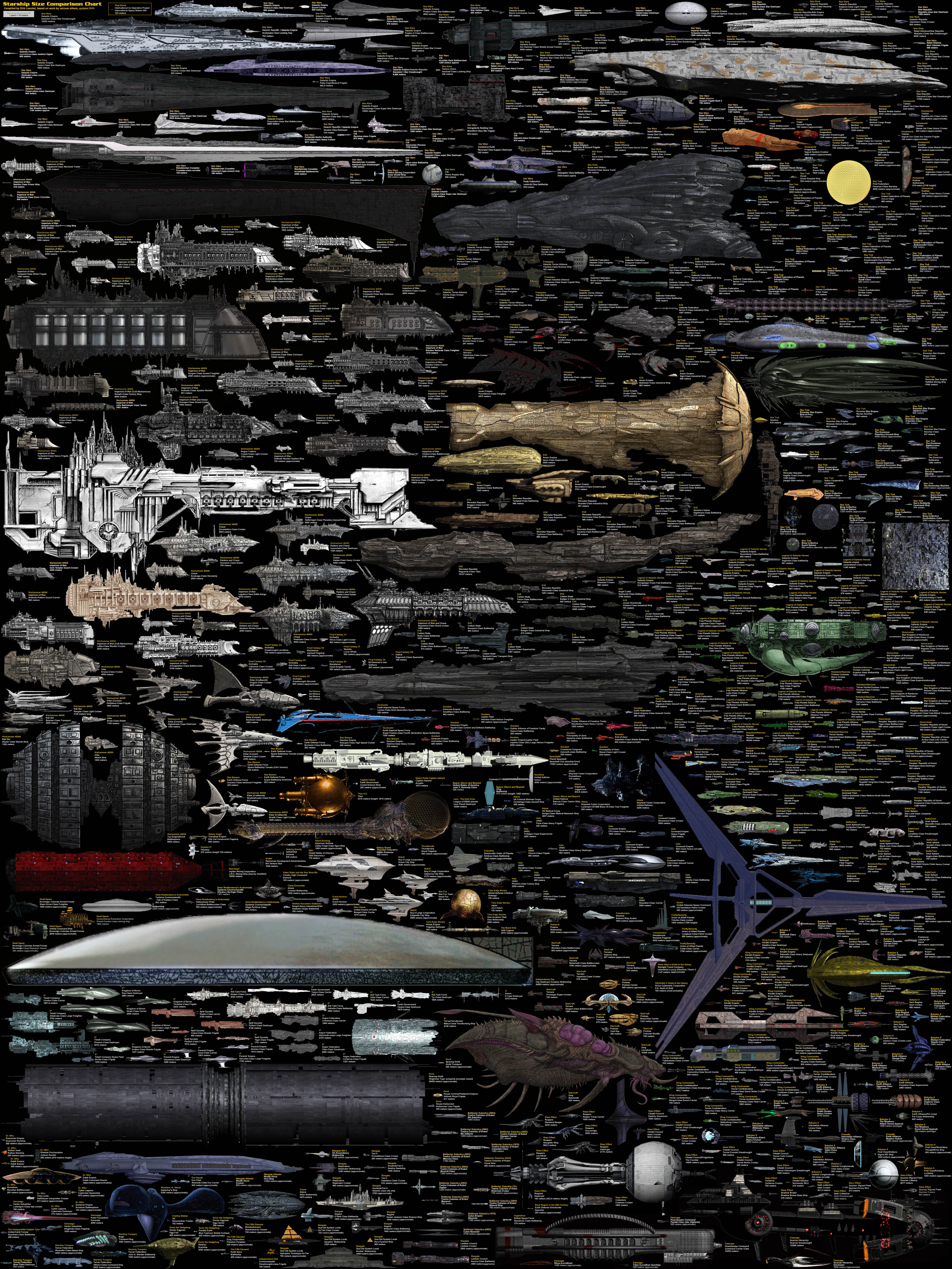
This is helpful from a number of perspectives... and also not. The fact of the matter is that with ships this big, it's almost counter-intuitive to try and stat them up. You can have information on them, but actually creating game stats to assault a celestial dreadnought borders on the ridiculous. How many interceptors and modified shuttlecraft do you need to take down the celestial dreadnought Vanquisher? Correct answer: all of them.
Friday, January 1, 2016
Character Sheet for Shards of Tomorrow
 Here's a draft of a character sheet for Shards of Tomorrow. Obviously, I'm sticking with the basic design here and just trying to give it the right setting vibe... I've added gender and homeworld spots just because, and played with the formatting to make things fit a little better. I think that a character sheet goes a long way towards establishing the vibe of the game (since it may be the only 'visual' a player actually ever sees!), and should be practical and evocative at once. Let me know if I succeeded...
Subscribe to:
Posts (Atom)