Showing posts with label Writing Process. Show all posts

Thursday, July 25, 2024

Of Foolish Consistencies

I remember as an undergrad being struck by Emerson's quote, "A foolish consistency is the hobgoblin of little minds". Not only is it okay to change your mind, but people who hang on to something too far past its natural end are foolish. Sticking with something just because you said you were going to is just plain dumb.

In some ways, I've tried to live by that. And in some ways, getting my books up for sale and building a readership on Amazon seems to be starting to come under the foolish category. I've read about how there's a glut of material there, and breaking through is really hard unless you are in romance (or *ahem* adult fiction) categories, and I don't think my book qualifies there. I realized that the Doc Stalwart book link for an ebook is broken, and cannot be fixed. No idea why. I can only sell it there as a softcover, and in the three years it has been for sale, I have sold exactly two. I'm grateful for those two sales... but, um... yeah. Not exactly setting the world on fire.

The first issue of Stalwart Team Up is in my publisher list, but it's marked as 'blocked', with no additional information. It could be that I'm still in the approval process (which can take a few days I guess), but it doesn't say that... it just says blocked. 

I think my people are on DriveThru. Maybe I should just stay there with them.

I'm circling back to simply putting the whole thing in one package - the comic story of 4-5,000 words, and then the 6-8 pages adapting it to the game. It's a pay-what-you-want download anyway, and this makes the books feel more substantial and in line with the others in the game so far (since they are averaging around 14-16 pages), and this would put the book well over that. I can fret a little less one month if I don't have as much subtance to add to the game (hey - here are three new characters, but the set pieces don't need maps and there is nothing else to add to the game really this time around)... I feel like it makes for a tighter package, and a cleaner presentation to the consumer (that would be you). My big concern was that, even with different coloring on the covers, there would be some (rightful) confusion for you all over which version of the book you are getting. 

And, if I ever get the whole Amazon thing working, I can always cross post the entire same package there (with the game material in the back), and if I get a few extra sales and more visibility out of it, all the better.

I'm going to start tinkering with the packaging. I'll let you know what I end up with...

Wednesday, July 24, 2024

The 'Best" Story

I have the first three issues of Stalwart Team Up written, and I’ve realized something about the format. I get to tell the best story for each of these characters, or at least a really iconic one. I don’t think this is necessarily the BEST Doc Stalwart story, for instance, but it’s one I really like. I got to write a different perspective for Doc. I love how the story I have written humanizes him more and brings a hint of tragedy to his whole story that is not present in the stories I’ve already written about him. Most of my stories are about the amazing things Doc has been able to do. This story, on some level, is about the things he never got to do. The small fights he never had time to take on, but that were still important. For me, it answered the question of “if you have Superman, why do you need anyone else?” Now, I know. I’m really happy with the answer.

As far as issue 2, it is, far and away, the best possible Condorian story I could ever have written. I absolutely love it. I have no need to write a Condorian novel (or even another Freedom’s Four story), because I found the perfect story to tell about both Freedom’s Four and Condorian, within the world of Tipo… I cannot tell you how much I love this little story. The fact that it expands the game world out in a nifty way is icing on the cake.

As far as issue 3… it is not necessarily the best Twilight Archer story, but it is absolutely an iconic sort of Twilight Archer story. I like how much it feels different from the first two issues, because he’s such a different character. It's also a very traditional sort of street-level adventure, which the other two are not.

My original thought was that I’d get to play with different genres by telling stories featuring different characters, and that is true, but I didn’t think about how the tone and themes would subtly shift as different characters came into and out of the narrative.

I also feel like the stories thus far have the right balance of character, moving the story forward, and action sequences. I’m very pleased with the story I’m telling so far. I’m looking forward to seeing what you all think of it. They also feel very rooted in the existing comics universe; I’m not doing a lot of world building; the world is already built, and now I’m just shining a flashlight into corners of it and examining those corners more closely.

The first issue should be up on Amazon in the next day or two (once it moves through Amazon’s pipeline), and I’ll release the RPG adaptation (which is already done) as soon as that goes live, so you can get them at the same time. I think I’m going to stagger releases to once a month going forward, just so I can place things through the school year and have some updates to keep releasing. I might even wait until August 1st at this point (which is only a week away), because then I can get on a ‘monthly’ release schedule that I can maintain. Getting two or three more of these done and ready to go before the end of summer is a reasonable goal and will give me a way to keep publishing and supporting my game for the foreseeable future, which is vital to its continued growth and success.

I still envision a ‘complete rules’ as a collection that includes all of the books so far along with some extra material that would be a single pdf and print book release… but that’s definitely on the back burner right now. I think that I’m in a position to let the game grow organically for a little while, and maybe build a stronger following, before taking that next step. I’d LOVE to do a Kickstarter, but I’d also want to have a big enough audience to support that, and enough reason (i.e. new material to add) to make a collection like that worth everyone’s time and money.

Monday, July 22, 2024

Taming the Muse... Or the Best Laid Plans of Mice and Men...

I had a plan. I really did. I wanted to build Stalwart Team Up by fleshing out a general narrative structure, playing through the scenario, posting notes, and then using those notes to compose the actual stories for publication.

My mind decided it didn't want to do that. Instead, I have already written the first two and over half of the third issue, and have yet to pick up any dice. The stories are just naturally fitting together, and the 'team up' model is giving me a very organic progression from one partnership to another. The first three issues feature Doc Stalwart, Condorian, and Twilight Archer, and I already know the plot of issue 4, and the character who will appear, Microbe. 

It looks now like I will get the first three stories done and up for sale, and then get to the work of adapting these into game supplements. I suppose the order doesn't ultimately matter, as long as there is a synergy between the paired releases. It is helpful to have this in mind as I write, because it is challenging me to write sequences that are also viable as game-based scenarios. 

This is a different process from when I was writing Doc Stalwart stories before. For those, I was entirely focused on the characters and the story I wanted to tell, and if an entire issue was two people sitting in a room talking, then it was. It didn't much matter that there were set pieces and interesting combat sequences for actual play. Now, this is a factor in my thinking, and the stories have a little more action and move a little quicker as a result. 

I've also drafted a chunk of the first game supplement for this, and realized that I can build this as three scenes with two cut scenes between, a prologue and an epilogue. So, a structure of four story-based situations and transitional cut scenes (layered with roleplaying) with a three-act structure of combat/encounters nested inside. This feels like a very workable model. Ultimately, I am giving myself freedom to deviate from the comic in the game adaptation because I want there to be a bit more action. For example, I add a sequence where Trash Talker and some Goonsquad members take part in an armored car heist. This is nowhere in the story, but is a side quest that gives the players another enounter before the big fight at the end. 

The only other challenge I see is with covers - I want the books to have the same covers (so you know that they are telling the same story), but I want it to be clear for you all which one is which. I have added a label of either 'for the world's niftiest superhero rpg' or 'a superhero story' at the bottom, so you know which is which. I think that should suffice. I also changed the banner color on the stories as well from yellow to dark red just as another visual indicator.

Monday, August 22, 2022

Writing Process: Comic Strips

I find the writing process for a comic strip is fundamentally different than other types of writing I have done. You have a very limited framework to fit ideas within, so things like rhythm, timing, and pacing are vitally important. A few word changes or re-ordering a sequence can fundamentally shift the entire strip.

Additionally, there are two competing forces at play when writing a comic strip; you ultimately want some payoff for the reader. There has to be at least a chuckle or a moment of 'aha' that a reader receives for their investment. It's a low-intensity interaction with a reader, but you want the reader to experience at least one thing during their time in that individual four-panel strip. On one hand, you want to pack as much stuff in as possible. On the other hand, this is a marathon and not a sprint; a long-range reading of some of the great comic strips of all time will reveal that they would have a 'theme' for a week (or longer), mining that idea for as many different individual strips as possible. However, the thinner you spread your material, the less likely you are to give a reader a payoff in each one.

With Teaching Ted, I want there to be three payoffs per strip. I want there to be something in the first panel that makes you smile or snicker or roll your eyes or something; the message on the chalk board, the cat meme on his desk, the sign under the superintdent's name plate - there should be some immediate encouragement for the reader to keep going. Panel two is the transitional building panel; it's the rising action. Panel three is the climax - that's the big payoff for that strip (I think) or a really powerful tease/hook for the final panel (which should be its own form of payoff), and then the final panel has the final downbeat and the closing statement. It's hopefully the best panel, and pays off the investment in the other three.

However, I'm finding that in drafting, I'm often combining two or three ideas into one strip for maximum payoffs. This is the strip I'm working on this morning...

This is one of my TV strips. The idea is that Ted is watching TV; this is my way to reflect on larger political and social events that have some impact on teachers and classrooms; Ted is a witness (often disengaged) to the larger forces happening that will ultimately force their way into his classroom (via his TV at home). In this case, I was thinking about the "don't say gay" policy in Florida, and how to blow this up. By the way, I've decided Ted works in a hybrid conservative state that takes the worst educational policies of the south and merges them into one super-state of awfulness. Anyway, the script started this way:

1. A NASA mission today went wrong when the controller was unable to stop the mission in time.
2. In his own words, "I didn't know if I could say abort. You know. Because of the other word".
3. That other word, as we all know, rhymes with PLAY. And, we will not say it either.
4. In other news, the governor has proposed a bill that would prohibit the public use of the word "abort".

It was okay. It's got a few little payoffs, and an ironic kind of twist at the end. It works well enough, but it's not great, and only borderline good.

I had another draft going with kids and toy AR-15s and them being a song and dance group that goes around doing patriotic songs. I didn't feel like I could get a whole four-panel strip out of that gag, but I fit it into panel one. Then, I decided to up the ante on the word you cannot say joke, and stay there for the rest of the strip. I had to pack things more tightly, but ended up with a much stronger draft:

1. Those local kids are so patriotic.

And cute! Those miniature AR-15s were adorable!

2. Now to national news. An unmanned space mission went awry today.

Apparently, the flight controller saw a problem, but here’s what happened, in the flight controller’s own words… 

3. I wanted to say abort, but I didn’t know if I could say that anymore. You know. Cuz of gay.

4. Turns out he was allowed to say abort, but will now face misdemeanor charges for the other word.


Then, I had to edit as I was doing the layout, because not everything fit on the page. I cleaned up and tightened dialogue due to limitations of physical space, and ended up with an even tighter draft. Here's the page with dialogue. I used different colors to differentiate the various people speaking.
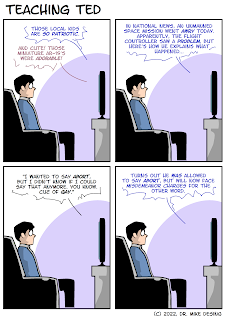
You'll notice that Ted has no arms here... that's because I've streamlined my process quite a bit. I don't draw a new chair or TV or even basic posture for Ted (unless needed) every time; for many pages, I have the basic elements in place, and then I'm just going to draw a hand and (in this case) a bowl of popcorn. He'll be eating popcorn as he watches; but I'm able to use 90% of the same drawing in every panel here, and add the 10% that changes. In some ways, my process is closer to animation than cartooning, because of how I'm managing pieces of the work flow. I've done one chalk board drawing; every time Ted is in front of the chalk board, it's going to be the exact same board design. Right now, I have ten different Ted postures drawn and two sides he can stand on the board; this gives me several thousand variations on how Ted can be standing at the board and talking to his class to work with. By building in these ways to speed up the process, I am more confident that I can maintain a schedule of two strips a week, and move to three a week if I get some momentum going.